
16th December: Bedford Branch Christmas Meeting
Once again, the branch sat down to recognise the end of a successful year of talks and events. 20 members and friends enjoyed a good supper from a local chippy with seasonal trimmings all put together by our remarkable team of helpers including washing up later. Special thanks to John, Sheelagh, Bill and Carole and the elf himself Steve for the raffle as he does every month.
Bryan Cross had put a DVD programme together featuring film of among other items “The Long Drag” an amazing film from the early 60’s made mostly by amateur cameraman Peter Bookock and of course covering the scenic splendour of viaducts and tunnels. He also paid tribute to the many men and women who constructed the line. One would wish that all lines of distinction had their own testaments like this one but the Settle and Carlisle has such a spectacular setting that it just lends itself to such a film.
While we dined there was a showing of “Night Mail” made by The Post Office film unit in 1936. Its curious in many ways especially the way the cameraman had to hang out of a doorway to capture the TPO mailbag drops and pickups. Auden’s words and the angular discordant music of Benjamin Britten still continue to stir the soul and perfectly suits the setting. This was followed by a later TPO version set in 1963, “Thirty Million Letters”. This time in colour but still action packed in a way that cannot be experienced any more by ordinary members of the public, like I did in 1965 on a dark night among Britania’s at Crewe and later at Carlisle with diesel traction.
After a look at a later film of diesel Locomotive manufacture in the UK and export we finished off with a Tom and Jerry. All too soon it was time to clear away and pack the goodies to await another party in 2026. Thanks again to all the helpers (CHJ)
2nd December: Trains in the Mist - Colin Brading
The subject area was those delightful little branch lines of mostly standard gauge that we all love but never had much of a chance but soldiered on often in decrepitude but sometimes lifted a bit by Colonel Stevens, who was a man of character and enterprise who put much effort into saving some of these lines or at least delaying their death sentence.
Colin was inspired while working for BR as an engineer in Wantage Road goods yard when an excavation picked up some brickwork connected to the Wantage Tramway. So, he is to be congratulated for researching a presently neglected part of railway history and taking his talk on tour which includes other lines not just the two we heard about
His first topic was the Brill Branch on its meandering journey through the Bucks countryside for 6 and a quarter miles. Opened in the 1870’s the line was originally horse worked and did not need parliamentary approval to operate. It had a relatively short existence but nevertheless supported the community through which it ran. The original supporters of the line were two of the principal local landowners, the main one being the line to run over their land and also provide a link for materials like coal needed for their estates. Colin had researched the variety of locomotives starting with old Aveling and Porter engines moving at about 2 mph, one of which has survived, No. 807. These and ancient coaches were followed by other machines including Manning Wardles and notably, later on, the Met used class A and D locos still fitted with condensing gear! After an 1890’s upgrade the line was leased by the Metropolitan Railway, passing to London Transport (the LPTB) in 1933 despite its long distance from London. The LPTB board were not interested in lines this far away and closed the Brill tramway in 1935.
Through a grand collection of old photos Colin visited the stations and we looked at the mix of engines in use from early contractors engines to the later Met machines. The line passed through wooded country and must have been a delight to travel on. Passengers looked a plenty during the lines heyday but began to tail off by the 1930s
For the second half of the presentation, we were taken on a tour of the Weston, Clevedon and Portishead Railway. At 14 miles it connected three coastal towns and ran through open countryside with good views. Opening in 1897 it started off running through the streets in Weston but the council had that part taken up. Surprisingly it had 19 stations or halts
Again, in numerous well put together photos we toured up the line visiting the stations and looking at the locomotives and old rolling stock and it was remarkable to see the set made for Argentina and looking rather exotic for a small line in Somerset.
In 1911 the redoubtable Col Stevens, the light railway king, took over who brought in various petrol driven motor cars on rails. The storage of fuel on the floor was mentioned as a great hazard. The line also carried some stone traffic and coal was collected from a river wharf. It was great to see that these lines are not forgotten and we look forward to another slice in time.
Thank you, Colin, for the work that went into the presentation. Excellent
4th November: A Broad-Gauge Journey, Part 2. Presented by the Rev. Canon Brian Arman (President of the RCTS)
We enjoyed a return visit by the Rev. Canon Brian Arman to continue his broad gauge journey this time from Swindon to Bristol with a diversion to Neyland. He is a clear speaker who keeps a surprising amount of knowledge in his head thus the talk flows with eloquent liquidity. It seems he has been collecting Broad Guage (BG) information since about aged 10 so by his mature years now a great deal of stunning images has been amassed and his knowledge of the subject is amazing.
Our journey began at Swindon, home to loos in the early days when Penzance trains of the 1880’s or earlier disgorged their passengers by agreement though 10 minutes seems a bit tight. In the far corner was the medical set up. An early GWR scheme to support its workers before the NHS was invented. The station and surrounds were viewed in many images often taken by photographer R L Bleasdale a notable pioneer of the railway photographers art and he was also hired by the GWR. Swindon dates from 1841 and we saw lines and locos from Broad Gauge days, with standard ('narrow'!) gauge coming in 1872.
En route to Gloucester we saw Brimscombe and Kemble with its decorated shuttered water crane done so as to not upset a local toff. The GWR went round that way enroute to Neyland, and absorbed the BG South Wales Railway in 1863.
At Cheltenham we saw what was the second oldest railway scene on a photo about 1848 of two ancient BG engines. All photos were superb in their ancient Sepia or plain black and white glory, a tribute to the fine machines on display.
Not all is smooth in rail travel so accidents feature as these were in a past a good photo opportunity and a number of accidents featured in our comprehensive tour e.g. at Lydney and Llanwern.
At Grange Court staff were seen sitting on a grassy bank in white jackets, clean and pressed and part of uniforms in those far off days. Our trip west went via Swansea showing the 1863 swing bridge accident on the BG Vale of Neath Railway and finished in Neyland with a wonderful view of the port area and extensive traffic.
Back at Swindon we completed our journey to Bristol with some more superb pictures of locomotives such locos as the famous Gooch 8 ft singles rebuilt by Armstrong; and covered stations such as Chippenham and Bath seen in all their glory. At Devizes we even saw a homemade broad-gauge shunter at a steel works. Where does he find them!
The pictures shown are individually stylish and gathered from many sources. We finished in Bristol with its magnificent train shed still standing today though not in rail use and a picture of the men who set up the GWR in 1833, including of course Isambard Kingdom Brunel.
Thank you, Brian, for a superb afternoon and we very much hope to see you back in the future (CHJ)
21st October: Annual General Meeting, and The Mid Norfolk Rly (MNR)
The branch came together for The AGM and all went smoothly with the minutes for last year's meeting approved. The chairman Bill Davis gave the annual report and thanked the many people who continue to support the branch meetings and events. The treasurer gave the financial statement and all was found to be in order with the branch solvent. The committee were re-elected enblock, and was the same as the previous year.
Full details of the accounts and meeting reports as well as branch officers’ reports can be supplied by our secretary (contact details on the main Bedford Branch webpage).
Bert Etherington, the Club Branch Liaison Officer, gave a short report on the main club. The LCGB is in good order financially but like many similar clubs struggles for numbers at meetings. The main committee have decided to help branches with a donation of £500 to spend or help towards e.g. new equipment to support branch meetings. He was thanked for the club’s generous offer. He commented that despite low numbers we at Bedford had a full branch committee.
After the formal AGM business there was a chance for members to raise issues and this was done by a discussion on a number of topics such as afternoon meetings and how to get more folks along. We do a certain amount of local advertising and put up posters where we can. On the vexed subject of when to meet we are trying out an afternoon meeting soon and other branches report a success with this. Local information - we do our best. Websites and Facebook were raised, which the committee will discuss as we have our own page but there are said to be many other railway themed pages locally.
Another suggestion was dropping LCGB and giving ourselves some other snappy name but maintaining the link.
It was said that as we are a hub for east/West rail why not a speaker but Bryan said no one would come forward.
The meeting ended with thanks from the floor to the committee and helpers.
Following the AGM Bert Etherington gave a talk on the amazing progress being made by the Mid Norfolk Railway, on which he is an active volunteer.
The line currently runs for 11 miles making it the longest heritage line in east Anglia. The most southerly station is Wymondham and at the northern end Dereham station has been wonderfully restored with trains being able to get a short distance north from the Railway's main base there.
Importantly the line has a connection to the main line at Wymondham for ease of attracting visiting locomotives but what is also of importance is storing rolling stock and carrying out engineering work for others. Sidings have even been constructed for the purpose at Kimberley where Network rail rolling stock can be safely stored.
17 miles is the eventual target, with trains running to County School station which has been restored ready for use and has a miniature railway attraction as well as a cafe.
Signalling and stations give the whole a very organised look and further work and restorations are due. On the locomotive front we were shown a variety of visiting locos both steam and diesel. The standard class 4 80078 is a regular engine but visitors such as 303 Squadron and inevitably that great crowd puller Flying Scotsman (Visited 2021) were shown in all their glory. There was also no shortage of visiting diesels as efforts need to be made to attract all comers.
The railway will be running special trains for Halloween and the unique to them “Polar Express” passenger train celebrating the film and providing a very popular event for families in the winter darkness
7th October: The MR Heads for Swansea, part 2: Brecon to Colbren Junction - presented by Chris Jones
Our meeting in October was an excerpt from the continuing journey of the MR towards Swansea from Hereford.
I say excerpt as the journey has been in several parts for a journey of only about 70 miles by road and about the same used to be by rail. Why rush though when there are so many pleasures to be enjoyed along the way. Chris Jones, our speaker has amassed memories, anecdotes and many pictures of today and yesterday often loaned by other railway photographers and acknowledged on the evening. Or the use of his own after shots having been too young at the time to have travelled on more than a tiny piece of the route. This time the journey in part two started at Brecon and ended at Colbren Junction.
Chris explained the complex arrangements at Brecon and how the one time three station set up was resolved into one, known as Free Street, where the various companies that used it - the Brecon & Merthyr, Cambrian, Midland, and Neath & Brecon - all had separate booking offices.
The westward way out of town now on Neath & Brecon, later Midland Railway, territory led to a band of prosperous country with the line following the river Usk passing two small stations Cradoc and Aberbran before encountering two Private platforms both beholden to branches of the ancient Garnons-Williams family. We spent a set of pictures discovering the Platform at Abercamlais, an ancient house which our speaker used to visit in the 1970’s. The present owners were delighted to discover their “station” and various artefacts all photographed. At Sennybridge station the army used to gather by rail and the Ivatt 2-6-0’s which hauled the trains never worked west
Over the hills now to Bwlch and its isolated loop and SB site at 1,270ft before running down to Craig-Y-Nos where we learned about an opera diva who regularly used the station. Also, a chance to see the “battle” scenes from the film Young Winston made on the line and featuring an armoured train about 1900 style. Ex GWR 1466 featured as the train engine towed dead from Didcot minus rods.
Journeys end was at Colbren Junction and the Prices Arms pub. The story continues to Swansea in part 3, sometime in 2026
2nd September: Scottish Railways in the 1960s. Presented by Michael Clemens.
The branch enjoyed another superb outing for the Clemens collection, as Michael Clemens gae another outing to his late father’s (Jim) collection, this time covering Scotland.
Michael is very active in touring the UK if the Railway Magazine listings page is to be believed, giving many enthusiasts a chance to tour branch and mainline Britain in wonderful colour photos and film which have stood the test of time, or if necessary have been revisualized using good technology. Michael also makes other material often downloadable and saved by his dad on the excellent family website.
Our tour towards Scotland started at Beattock Bank with views of the days of assistance by Fowler tanks but as we noticed elsewhere trees now intrude into too much of the landscape. At Lockerbie we took a left turn towards Dumfries and the coast stopping at various long lost station outposts and viewing some splendid signal boxes. There was a Caley Jumbo 57375 glimpsed on its last run. The HR 103 was also out on tour. The line in from the east is now long lost so we are grateful to it being well photographed. The dock station at Stranraer is now most inconveniently located.
On up the long Ayrshire coast with inland colliery scenes seen with steam lingering into the 1970’s. Ayr station is now less messy with that derelict hotel now removed. As a bonus we saw the CR single No 123 at Kilmarnock as we worked our way up the Ayrshire coast. At Muirkirk iron traffic appeared with No 61342, we were far inland and nearly off G and SW territory but the journey was worth it. Over on Caley territory a long way to Lanark and into Carstairs on the way passing another fine box at Douglas West. At Carstairs main lines beckoned and so we moved on to Glasgow central with a sight of the magnificent 60009 "Union of South Africa” looking splendid. At Greenock pier were nearby lost Scottish industrials, Sentinels to be precise.
Then away to the north. Callender in passing was a reminder that it was the location for Dr Findlay and his adventures. Oh, the days of gentle Television. Away up the highland main line and how majestic it looked in the photos All the way to Fort William haulage by Glen Douglas and a J37 to help out. Everywhere travellers like disturbed ants swarm over the tracks at each stop. Back down and over to the east via Elgin, Brechin and the Edzell branch.
Depot visits as we ran south to terminate out inspiring trip at Hawick.
Wow a lightening but very satisfactory tour.
In the second half the DVD selection came out with both Sir William and Sir Nigel in action. My highlight was the rush up the Waverley route with engines working flat out to give the highest DB effort ever recorded by steam and it looked it too (CHJ)
6th August: Bedford Branch Chairman’s Outing 2025
10 members and friends set out on a prearranged visit to Bricket Wood station on the “Abbey Line”, the Branch from Watford Junction to St Alban’s Abbey, unfortuanately in the absence of Chairman Bill who sent his best wishes.
Travel from Bedford was on the 09:24 to Bletchley a train that had spent nearly an hour idling in platform one. The guard cited “old stuff” making it difficult to start the engine if switched off. We added significantly to the passenger count but were pleased to have our tickets checked on the way. Then at Bletchley it was a quick walk across the platform to catch a train to Watford Junction and this was very crowded so we stood all the way as no one gave their seat up to OAPs! Your scribe was caught unawares as the up slow to up fast crossover was taken at max allowable speed(?) to find me mincing about in the vestibule.
At Watford Junction it was a short walk over to the Branch train to St Alban’s Abbey in platform 11. Two more members joined the party at Bricket Wood having arrived via the 321 bus from Luton to St Albans Abbey then the 11:08 to Bricket Wood.
Arrival at our destination was a delight as the original upside LNWR building with its mellow brickwork has been saved for the nation from a state of dereliction and was restored by a dedicated team with some grant aid and reopened as an attractive café with internal walls removed to make one long room. We all enjoyed coffee and cake then the tour before a prebooked good lunch. We were lucky as the archive team were all on hand to allow us to look at archive photos and books and then gave us a talk and a chance to hear about the serious work that has been carried out. The station has excellent benches and sufficient traditional signs to make a pleasing contribution to the eye. The staff have been trained by Network Rail to work on what is an actively used station as the café is not fenced off but accessed directly. The whole is in a pleasant setting with explorable countryside adjoining and some interesting buildings including a row of former railwayman’s cottages along the rd. to the local hostelry whose beer a few of us partook off.
"What’s that next door with the chimney?" I asked a passerby: “It’s a nuclear bunker!” I didn’t believe him but it was.
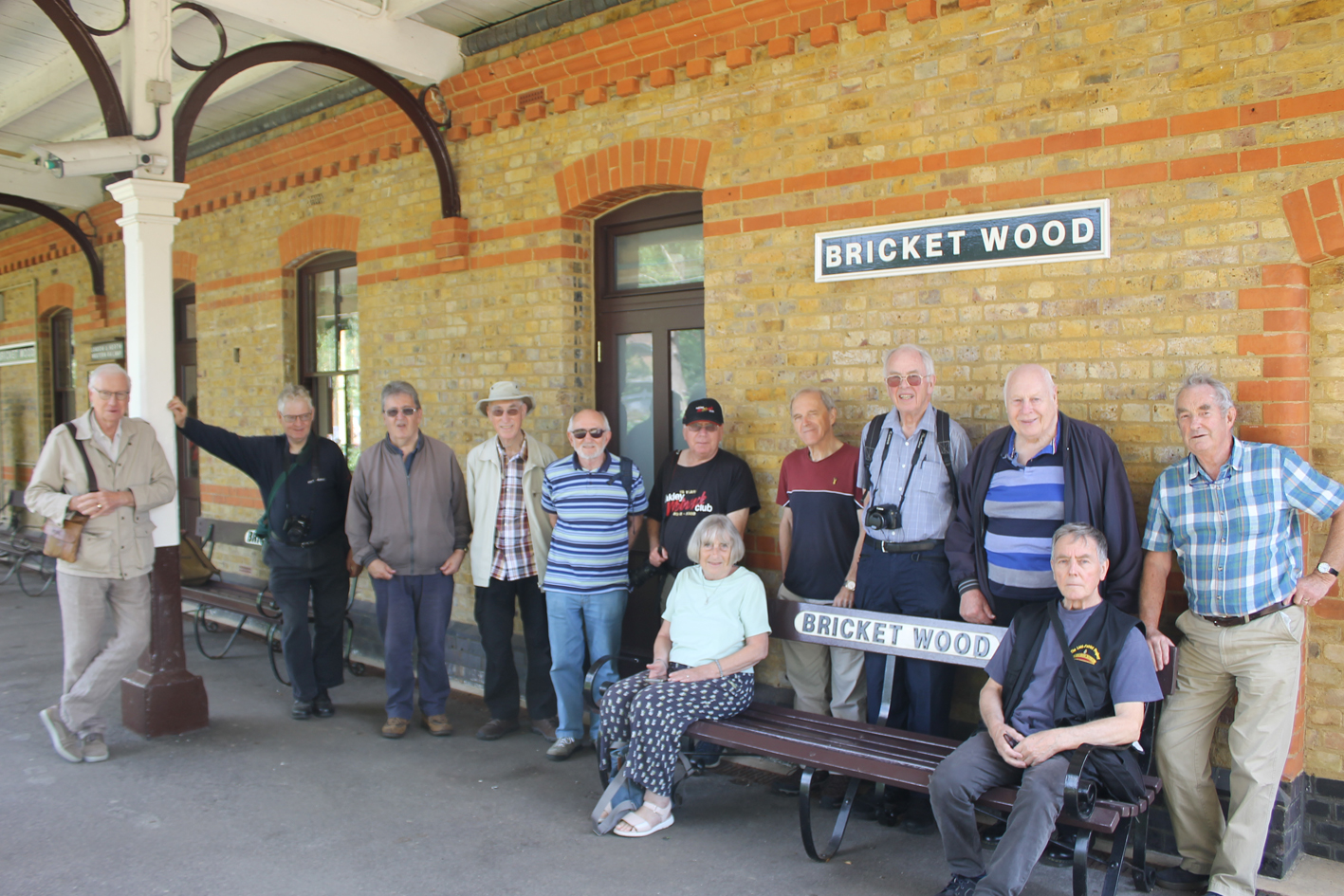
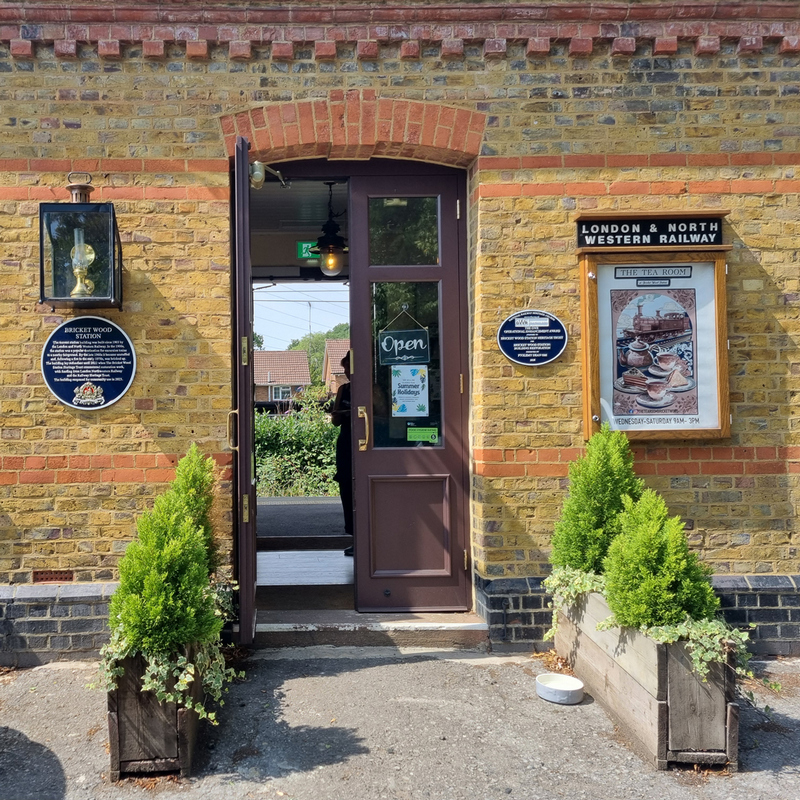
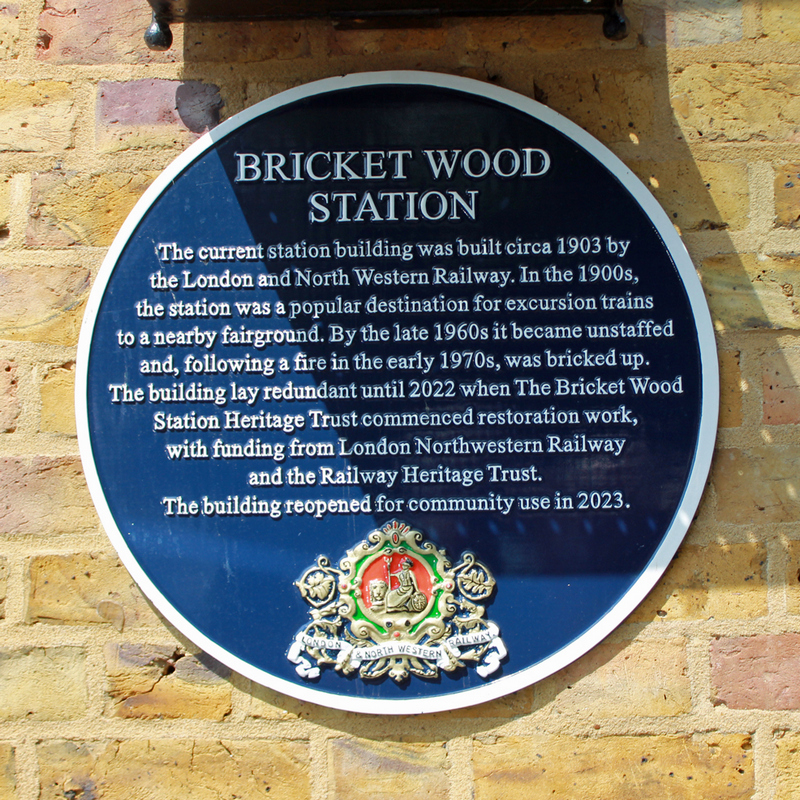
The Branch Party at Bricket Wood, 6th.August 2025 (Image: Chris Jones), with, below, the Bricket Wood Station Tea Room entrance (Image, Bryan Cross), and a close up of its blue plaque (Chris Jones)
All too soon we boarded the class 350 unit for our trip back. The branch is single line but a few years ago to improve capacity there was a proposal to reinstate the loop at Brickett Wood but unfortunately it came to nothing.
North from Watford seats were available but rather short at Bletchley as the station café only has two chairs with two small tables. It did have three but the barista was sitting on the other one!
There was time however to go and look for the London to Birmingham salvaged stone sleeper blocks making a wall behind the car park. Back at Platform 6 glum looks were exchanged among the Engineering staff as they peered again and again at the engine of our unit so we were relieved when the driver got in and we set off. Apparently, there was a leak in the exhaust so off to “Quick fit” for a new one.
On leaving Bletchley for Bedford our attention was raised by an unfamiliar noise as we were passed south by a returning ex SR EMU being towed south by a diesel we failed to spot. Apparently, it had left Derby at 09.30 so had been hanging about a bit.
A good day out was had by all. Thanks to John for organising and the helpful archive and buildings team at Brickwell Wood of Fran, Nigel and Paul.
Looking forward to the next one with the real chairman in place. (CHJ)
1st July: Great Central Railway Re-Unification - Tom Ingall
Tom Ingall delivered a polished talk on the intricacies of GCR reunification to the Bedford branch for our end of season session in July.
This project is the most significant engineering and infrastructure undertaking to hit the heritage railway industry ever and may well remain so in the future. Compared to HS” it seems to hit all the right spots and there is no talk of massive cost overruns here.
Tom is a long-term volunteer (he said it was better than being in the scouts) and career journalist with the BBC and he gave us all we needed to understand things, with a blend of history and current practice including brilliant film and animations of parts of the engineering output. all put together and delivered with a professional’s art.
He began with the challenge of identifying the “Railway King” Edward Watkin and his great project which the GCR became. He spread his influence widely and in my own sphere Watkin even becoming the chairman at one time of the little Neath and Brecon Railway and taking the MR to court! But that’s for another time. Watkin’s GCR opened in 1899 and was a splendid main line straight double track and well-engineered but perhaps a little late on the scene. He told us about the great work of Leicester based photographer Sidney Newton who recorded the construction of the line on amazing photographs now all available on line.
Coal was moved to London in vast amounts during its 24 years of independence with sleek engines and fast Edwardian expresses but it seemed as soon as the line opened its run down followed with few friends especially when it was gifted to The LMR in the 1950s. I remember a night trip behind a Black 5 in late 1965 over a badly run down system. Shortly after in 1966 the end came with passenger closure south of Rugby followed by the now preserved section in 1969. With the early stirrings of preservation starting almost immediately after.
The reunification of the two-line sections to make an 18-mile line has always been an ambition so Tom went over the story so far and a great one it is. For those who don’t know the GCR South is 8.2 miles from Loughborough to a new terminus called Leicester North. The Northern section Great Central Nottingham or “Nottingham Heritage Railway” as it is now known is longer at 10mls and with a connection to Network Rail.
The 1980 removal of bridges by BR has not stopped the re connection process. Things got going in 2014 and progress has been amazing since. To rejoin the lines requires canal and rail bridge replacement. Road overbridge replacement works as well as embankment reconstruction or replacement. Paul was pleased to announce to us that the planning permission had just been granted so much more and rapid work can now be set in train. Amazingly already the canal bridge is back as is the Bridge over the Midland main line. We watch excellent film of road bridge demolition and reconstruction and learned how the canal bridge was refurbished and major parts repaired and replaced. Instead of a long embankment and imaginative long bridge on piers is to be constructed. There will be many problems to solve along the way but all looks good for the future and must this give succour to other heritage railway societies with similar construction tasks to carry out. The expertise here and learning is vast and show what a professional lot the heritage railway industry has become. We can encourage it all by visiting the GCR as your scribe did in 1970 and more often recently. We hope Tom will be rewarded by being invited to take his presentation along to many other LCGB branches and other clubs are available. Thanks for a fitting end to the season.
3rd June: Making Tracks? - Sean Devaney
This meeting was rather different, as instead of the usual run of photographs to illustrate a talk our speaker used just a few photos to support his thoughts on the issue of track maintenance and renewals and his very successful time working on the railway.
His father was the crossing keeper at the near to us Kempston Hardwick, so the now long demolished Kempston Hardwick Crossing Keeper's House was his family home until the 1980’s. He described his appointment to a job with the then BR as a rail enthusiast’s dream come true.
His early jobs as an engineer involved such operations as the new station at Milton Keynes (visited when new on a local outing by LCGB Bedford) The re-signalling on the Midland main line including Bedford and an anecdote involving an empty Fish van and its highly olfactory content. A ghostly apparition one night in white was another scary one. In fact, it was difficult to keep up with all the amusing tales of life on the railway.
Lidlington tip was a local institution, and Sean had many memories of dodgy goings on in its vicinity and on the sidings nearby where frequently ballast was overloaded onto wagons a common occurrence there and elsewhere. He talked openly about the difficulties of managing infrastructure renewals under both Railtrack and Network Rail who were in turn being driven by the demands of the Treasury and how this manifested itself in inefficiencies and lost opportunities, and the increasingly aggressive contractual attitude shown to the principal Infrastructure Renewals Contractors after the transition into Network Rail.
As his career gained pace so did privatisation and with it came many problems. These were gleaned from his time working with companies like Jarvis, Grant Rail (now Volker Rail), Carillion, Amey and Balfour Beatty on various locations on the ECML, Anglia, WCML and many other places. This was 1998 onwards.
In 2002 he went to Carillion to tender and plan and subsequently manage the remodelling of Nuneaton North Jct and station and the reinstatement of the former flyover to enable cross-country services to cross over the WCML. On completion of that in 2004 he was recruited by Amey Rail to take control of and turn round the Thames Valley track renewals team who were performing so badly that Amey was expecting to lose the Contract. This track renewal area contained the largest mileage of 125mph track in the UK and during the following two years he introduced new practices to improve efficiency before being engaged by Balfour Beatty Rail in 2008 to work on the renewal of the Up Birmingham Flyover as the precursor to being awarded the remaining outstanding reinstatement of the downside lines at Rugby.
 Track Renewal, 3rd December 2022. Image: Sean Devaney
 Northampton S&C Renewal, 14th May 2006. Image: Sean Devaney
A major part of his work was on plain track renewals and the resultant removal of spent ballast delivery of fresh ballast and putting track panels back. He made many comments about the vagaries of cooperation or the lack of it between the aforementioned companies and Railtrack a dodgy monolith by the sound of it
This especially involved the thorny issue of possessions sometimes not arriving in time or describing the perils of overruns.
You would be well advised to meet him for a drink in an unobserved place in your local pub to hear more and witness the beans being spilled
Do invite him along it’s well worth it as he is new to the circuit (CHJ)
6th May: The North Eastern Railway - Ray Schofield
Local member Ray is to be congratulated on his research which is always thorough and shows up in all his presentations: tonight's presentation was clear and well delivered and in an entertaining manner with many maps and plans to help those unfamiliar with the locations.
The NER came into existence in 1854 by the amalgamation of numerous small companies too many too list all of them but included were The Tanfield Railway, originally a wagonway dating from as early as 1725, the Middleton Railway in Leeds, the iconic Stockton and Darlington Railway, the Clarence Railway, Stanhope and Tyne Railway, the Newcastle and Carlisle Railway, the Leeds and Selby, and the Knottingley and Pontefract. Ray explained how this ragbag of companies metamorphosed into one of the major pre-grouping companies.
 Tanfield Railway Causey Arch 18.8.2004. Image: Bryan Cross
 Tanfield Railway 0-6-0ST No 49 Taking water, 18.8.2004. Image: Bryan Cross
For his talk Ray chose classic NER locations to illustrate his research. York and Newcastle featured prominently
One of the principals of the NER was the great George Hudson who was a native of York and was known as the railway King but discredited later. We learned how Hudson controlled a large part of the East coast mainline of the NER especially a grouping leading to being merged to form the York & North Midland Railway with George as its chairman and George Stephenson as chief engineer and onwards to where the line joined the GNR near Berwick on Tweed.
Ray described the original way to York from London which was from Euston to Rugby and via the Midland to Normanton. The later GNR and NER route was significantly shorter.
The original station at York was inside the city walls so we learned how it was altered from a tricky arrangement requiring reversals. Eventually the spacious modern station was constructed but on a tight curve to access the Scarborough and other lines. It remains an interesting place to observe traditional trains attempting to make a clean start.
Moving to Newcastle and its classical and well thought out location with the magnificent and complex lines highlighted at the approach to the King Edward 7th bridge.
One wonders if anyone has attempted a model of the layout here with its complex signaling (probably!) The NER it turned out was also a pioneer in electrification using 1,500v DC a system used by BR until superseded by 25kv AC.
The final part of the talk featured numerous famous locos on rail tour duty often photographed by Ray himself either in BW or color. These included ‘Sir Lamiel’ representing the Southern team and ‘Golden Fleece’ the local boys.
No doubt Ray will be back with another thoughtful and well researched topic. (CHJ)
1st April: The Deltics-Worthy successors to the A4s? - Michael Smyth
Tonight's speaker posed the question as to whether they were, and at the end of the evening your scribe was convinced that worthy they were. Not because they were any better or faster or more reliable but they were such sound workhorses that the NER through them could continue the fine tradition of east coast express services set up when by The LNER when the A4’s came on stream in 1935 to the last of the Deltics in 1981 a fine record for both beasts.
Michael has researched his subject impeccably and so the story began by recounting the development of the Deltic engine as German design and engineering back in the days of Maybach with early diesel developments. The illustrated “Flying Hamburger” of May 1933 looked like a boat but was an early kind of HST. Early diesels were available to the likes of The LNER but it was decided to go with a modified A4 steam locomotive which became The A4.
The range of diesel engines covered Napier/Junkers/Maybachs and English Electric and on the way wartime engines like the Deltic type Cummins engines fitted to the WW2 naval MTB, s and remembered as the navy’s very fast “little ships” (A description also given to the civilian owned Dunkirk rescue boats). These marine engines emerged as the motive power for the new Deltics with the prototype named “Deltic” running in 1958. Then all coming fully into service in 1962 to operate express services on the east coast main line and soon replacing the noble A4’s which they did so in a smooth manner and eventually 22 were constructed.
The full range of Deltic work in pictures included their outstanding main line work on all kinds of services then an array of special work including some memorable shots such as at Leeds and at Riccarton Junction on a last day special.
By 1976 they and their engines were wearing out and the HST’s were on the horizon and what a worthy successor they proved to be.
Numerous specials were run in the 1980’s and the entire class ended up at York by the late 70’s until a last trip under BR in 1982.
 Kings Cross. Non stop to Edinburgh 27.2.1982 Image: Michael Smyth
 Deltics: the last Gathering, at Doncaster works 27.2.1982. Image: Michael Smyth
However, we are lucky and 6 A4’s and 6 Deltics have been saved in the UK and we enjoyed the great gathering photos before an entertaining discussion took place between the assembled members and Michael with Bill Davies describing his adventured in manning Deltics in the early part of his railway career. My own memories are of being lost in winter fog in the fen country when the only sound I could hear were Deltics powering over Connington towards Yaxley.
It was all most entertaining so thank you Michael
4th March: Stuart Underdown’s Southern Memories - Jeremy Harrison
A merry tour of the South and South West, starting in London, was our entertainment on March 4th. Jeremy Harrison had made a journey from Croydon to show part of The Stuart Underdown Collection which he looks after. Presently all on slides but they mostly worked smoothly. We were treated to an amazing colour tour and as someone who remembered London Smog at Vauxhall I was pleased to see such clear shots of the area and its rushing expresses and many dying days of steam specials and even a diesel or two. Many locos by the 1960’s had become very grubby but on tours they were cleaned up for our and others enjoyment. RCTS and LCGB rail tours were featured in their great variety in the late 60s, interspersed with service trains.
Nine Elms was visited as part of the evening and a depressing sight it can be when he went in 1967. It looked better in 1963. Out we went to Clapham Junction and on to Woking and Basingstoke right in at the end but interspersed with some older shots such as Schools and a King Arthur class. Eastleigh shed and works were visited a few times, and many locos were seen both in store and active. Preserved T9 was seen in the works for attention looking splendid in its LSWR green paint. Stuart had been into Southampton dock and captured a few Austerity USA dock tanks like 30064 now rumoured to be hiding somewhere on The Bluebell. At Southampton Central it was a splendid signal gantry that featured along with another rail tour. We travelled onto the S&D enjoying views of Evercreech in 1965 then some particularly good shots of Highbridge station and yard with a 4F on tour.
At Bath Green Park we encountered a very clean Bude on another tour in 1966.
At Seaton two clean Ivatts featured in a great photograph. In fact, each picture told a great story of those rushed days at the end of steam and the many rail tours and last runs operated.
The far west based on Barnstaple allowed view of steam on branch activities and out to Bideford then down to Torrington which looked classic with the arrival of the three coaches from Waterloo as part of The ACE with 41283. Moving on to a wooded scene with 41283 calling in the woods.
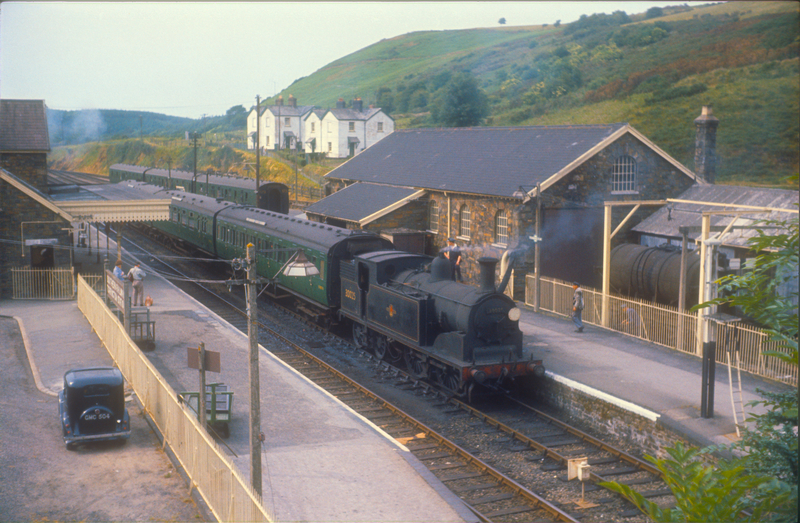
In 1962, while the Atlantic Coast Express would have left Waterloo behind a Bulleid Pacific, at journey’s end it would be something more modest, such as ex LSWR Drummond M7 0-4-4T, seen taking water after bringing in the Torrington portion. Image: the late Stuart Underdown.
Our tour continued down the Swanage branch with a Q1 on tour “The Wealdsman”. For fans of rail tours the whole evening was a gem and with much to remember for participants. Not forgetting the railmen who made it all possible. So, we saw a smiling locomotive Inspector Oliver by a loco at Christ’s Hospital
Finally, after a Vectis and Hayling island tour we finished off with engineering work at Stuart’s local stations Lewisham Road and Ladywell showing the kind of scenes impossible to photograph these days. A great shot of Thermit welding! Wow.
We concluded with some old B and W pictures including a 1915 station queue for spuds!
The ride was extensive and rapid but we were very pleased with what we saw the quality and variety were excellent. Thanks very much Jeremy. Is there a part two? We hope so. (CHJ 10/03/25)
4th February 2025: British Rail a New History - Christian Wolmar
Christian Wolmar was our notable branch speaker for February. Take one look at his web page and you will see his many achievements set out before you as well as a very busy timetable. The branch was therefore very lucky to have him before us and to enjoy his company. As the oft quoted media sage on railway matters, he lived up to his reputation. His numerous books were spread out before us for sale and those like me cash and card poor will be surely investing in the coming days. His latest book on the rise and fall of British railways was his topic but other books were available including a 2025 book on how the railways of France were rapidly reconstructed after the Normandy landings. This involved The USA in that the commanding 3rd Army General George Smith Patton who in a Trumpesk move had vast numbers of men navvying for months to ensure his petrol got to him by rail (Or was obtained from other units), this looks a fascinating book.
He returned to British Railways and Christian recounted its birth out of the wreckage of WW2 and was followed by nationalisation in 1948. At that time the railways enjoyed a post war boom and employed vast numbers compared to today 600,000 were quoted with 10,000 shed each following year and the BTC had its tentacles everywhere in a network of docks, canals, hotels, sea and land enterprises. The compensation payment to the previous companies was no doubt a welcome legacy to them. The numbers of employees were also swollen by 1000, s of horses and their needs. To add to the burden was the “common carrier” status which produced much unremunerative traffic (Yes, I remember two greyhounds tied to a lamppost overnight at Swansea High Street and a bag of decomposing cockles).
The photos shown were an eclectic mix as the topic developed. The modernisation plan was unveiled in 1955 but in some ways just offered a bit more of the same rather late with the wasteful construction of vast marshalling yards for unbraked wagons and new steam engines still being built. Closures continued on a piecemeal basis though during that period.
Then along came Dr Beeching with his much stronger brew amounting to virtual euthanasia in some minds and places but iconoclastic thinking to others. Out went steam and in came MGR trains and marketing. Musty rolling stock was disposed of. We should remember though that railways often benefit widely those people who don’t use them.
Into the 60’s with Marples and Castle brought further changes when Christian recounted that the railway was now to be split to a social side and a commercial side. There was much innovation and forward thinking with The APT and 125 concepts - the 125 won.
Under Thatcher came sectorisation and then the sell off all talked about in detail. He was clear that railways cannot flourish in Britain without some kind of government intervention and control and more of this is coming up with GBR. He did however finish off with praise for Peter Hendy and his role as the rail minister. If that leaves you wanting more then buy or borrow the book “British Rail a New History by Christian Wolmar. An excellent evening which terminated with questions and answers ably dealt with by our speaker.
7th January 2025: Bedford to Cambridge - Stephen Owen
This was the first meeting at Bedford of the New Year 2025, but it started on a sad note as Chairman Bill Davis asked members present to remember in silence our great friend Peter Neal who passed away rather suddenly in December (there is a tribute to him elsewhere).
Our speaker was Stephen Owen who is new to the branch as a speaker, but gave a very thorough history in words, pictures and text of the building and history of the Bedford to Cambridge Railway.
This is a line likely to reappear in a different location in the future as part of East/West Rail and Stephen covered that at the end of his talk in fact he reminded us that The Doctor (Beeching of course) did not include the line as part of his 1963 medicine and even proposed its development as an important cross-country link. However, “Battling Barbara Castle” had other ideas and it succumbed in 1968.
It is interesting that AI (Internet search) has it as a Beeching victim and our speaker amused us with an AI reference when he looked up George England, builder of Shannon, the engine on the Sandy to Potton Railway of 1857, he got information on young George Windsor by AI!
Stephen lives at North Rd Station and he has done an amazing amount to transform it back to its place in the railway landscape as it was soon after construction and opening in 1862. With even a reconstructed LNWR signal box as was, complete with frame.
After talk of canals, various routes were proposed for a railway which, rather like today’s East-West schemes, seem to wander around a map.
After opening the line was absorbed by the LNWR in 1865 who ran 7 trains a day and connected up with the Oxford line so the whole was known as “The Varsity Line” and might one day be again.
We saw various experiments with railbuses and railcars. In the 1950’s after nationalisation it ended up as part of three BR regions so no one seemed to care for it, So eventually a gradual run down came and closures of facilities then the sad end.
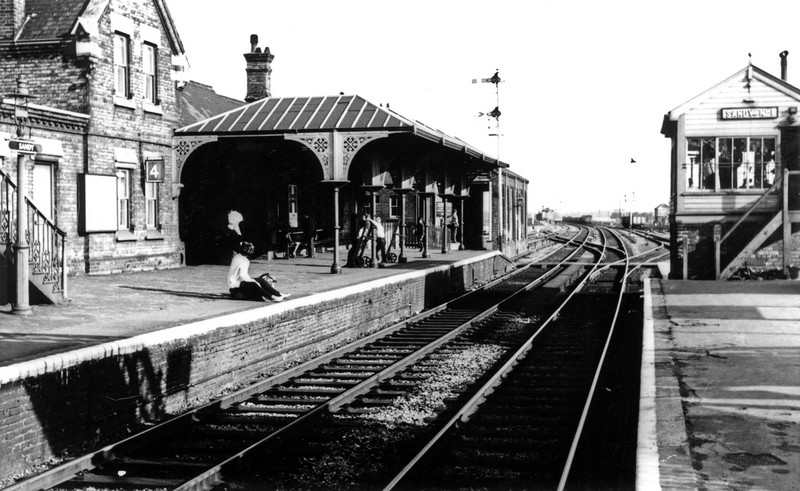 Sandy LNWR side, 1st June 1963
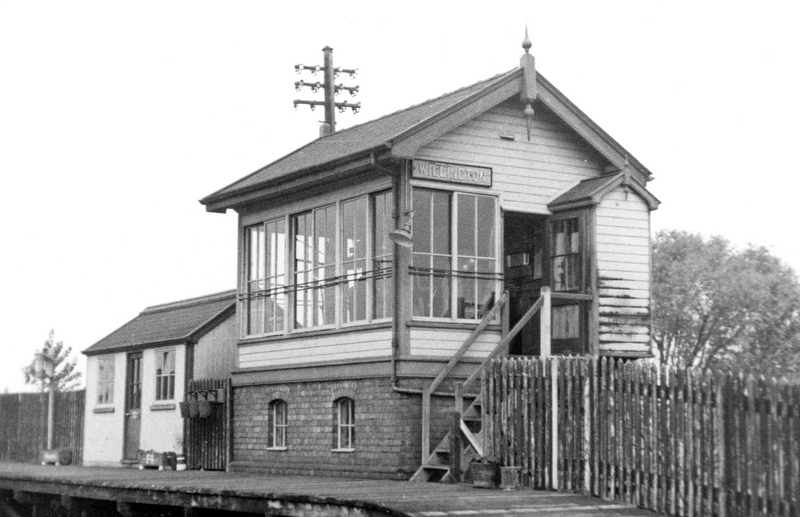 Willington Signal Box, circa 1965
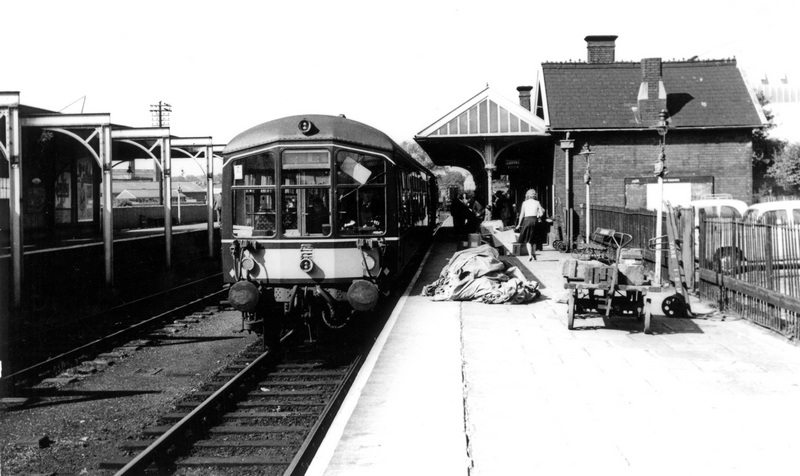 A Derby lightweight DMU at Bedford St John's in the morning of Saturday 31st July 1965
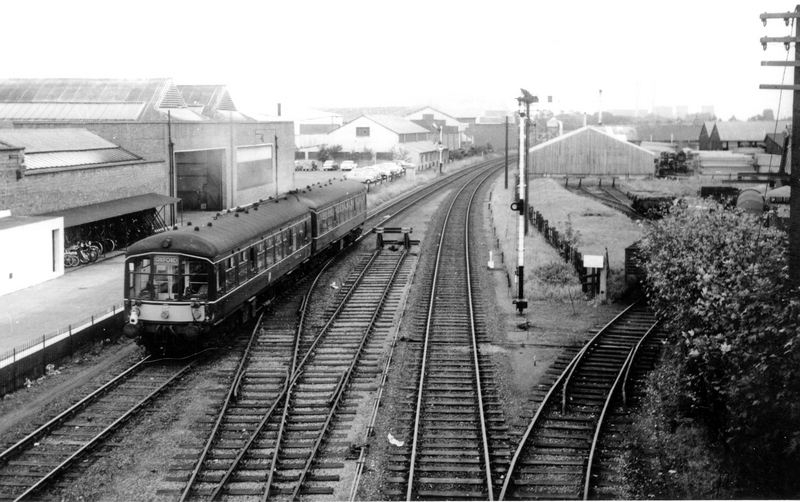 On the same day, a Derby lightweight DMU leaves Bedford St John's for Cambridge, looking east from London Rd Bridge, with Stirling's sidings on the right.
Our tour of the line was very thorough and covered stations, both in their heyday and as they remain today, often put to good use. Loops of all kinds showing that Stephen had done and continues to do a great deal of research into the remote loops and signal boxes often put in to cope with extra traffic in two world wars, showing the vital strategic nature of the line.
He showed off various artefacts - Webb and Thompson staffs, both standard and miniature, as well as numerous publications, both official and others. Maps and aerial photos gave additional coverage and the branch were also reminded that uniquely we had two people present who lived in stations on the line, as our old friend George Howe was also with us from Potton Station.
A superb evening for which we gave great thanks.